
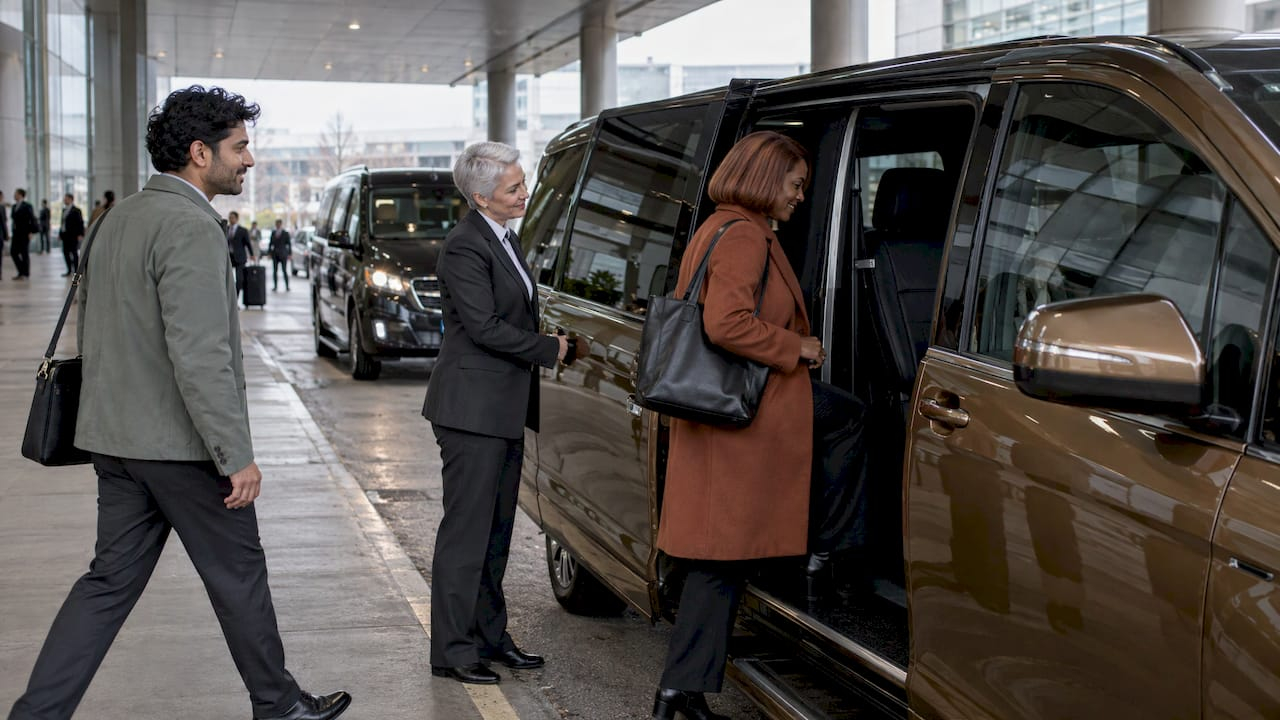

Corporate group transportation is the planning and running of ground travel for several executives, employees or guests: airport arrivals, hotel runs, meetings, venues and departures, all on one schedule. It works when one team owns the whole itinerary, knows every passenger’s timing, and can change the plan in real time. This guide shows how to build that plan for Toronto and Southern Ontario, step by step.
TL;DR
- Treat the trip as one itinerary, not a set of separate rides. Arrivals, meetings, venue runs and departures should sit in a single schedule with one point of contact.
- Start early for anything tied to a hotel block or conference. Longer lead time means more choice of dates, hotels and terms, and international groups need the most.
- Collect passenger names, flight numbers, headcounts, luggage, accessibility needs and stop lists before you quote or book.
- Build buffers around flights and meetings, and agree in advance who can authorize a change on the day.
- Check vehicle capacity, insurance and accessibility with the provider in writing before the date.
Table of Contents
- What corporate group transportation includes
- Choose the right vehicle mix
- Information to gather before you book
- Start with the calendar
- Build a schedule that survives real life
- Coordinate executive transport with everything else
- What airport transfers cost with us
- Vehicle, safety and accessibility checks
- Keep it reliable when plans change
- Our perspective
- Plan your group’s travel with Nero Limo
- FAQ
- Sources
What corporate group transportation includes
The label covers more than a bus. In practice it means any managed movement of people for a business purpose: a leadership team landing on different flights, a client delegation moving between a hotel and head office, or a conference with hundreds of attendees and several venues.
The common pieces are:
- Airport transfers with flight monitoring and a meet and greet at arrivals.
- Point-to-point runs between hotels, offices, restaurants and venues.
- Hourly or as-directed service, where a vehicle and chauffeur stay with a group for a block of time.
- Intercity legs, for example Toronto to Niagara-on-the-Lake, Hamilton or Burlington for an off-site.
- Event shuttles for conferences, roadshows, galas and large public events.
It is most useful when guests are time-sensitive, when more than one person is travelling on different schedules, or when the cost of a missed meeting is higher than the cost of the ride. A single executive transfer and a multi-day roadshow follow the same logic. The second one simply has more moving parts.
Choose the right vehicle mix
Groups rarely fit one vehicle type. A sensible plan matches the vehicle to the passenger.
| Situation | Typical approach |
|---|---|
| One or two senior executives | Black car sedan or SUV with a dedicated chauffeur |
| Small team of up to a handful of people | Premium SUV or a Sprinter van |
| Larger delegation arriving together | Sprinter vans or several vehicles dispatched together |
| Conference with fixed start and end times | Multiple vehicles on a rotating loop, plus a few on standby |
| Mixed-seniority group | Executives in black cars, the rest in vans, same itinerary |
We run black car and chauffeur service, with group movements handled through Sprinter van bookings and multi-vehicle coordination. If your group is large enough that you are weighing a charter coach, tell your provider the headcount early so the plan is sized correctly from the start. Our corporate event transportation in Toronto page explains how we set up event movements.
Information to gather before you book
Most last-minute problems trace back to missing information at the start. Before you ask for a quote, assemble one document, ideally a shared spreadsheet, with:
- Passenger list: full names, company, role, and a mobile number for each traveller or their assistant.
- Arrival and departure details: airline, flight number, terminal and scheduled times.
- Headcount and luggage: how many people travel together and how many bags, including oversized items such as display cases or AV equipment.
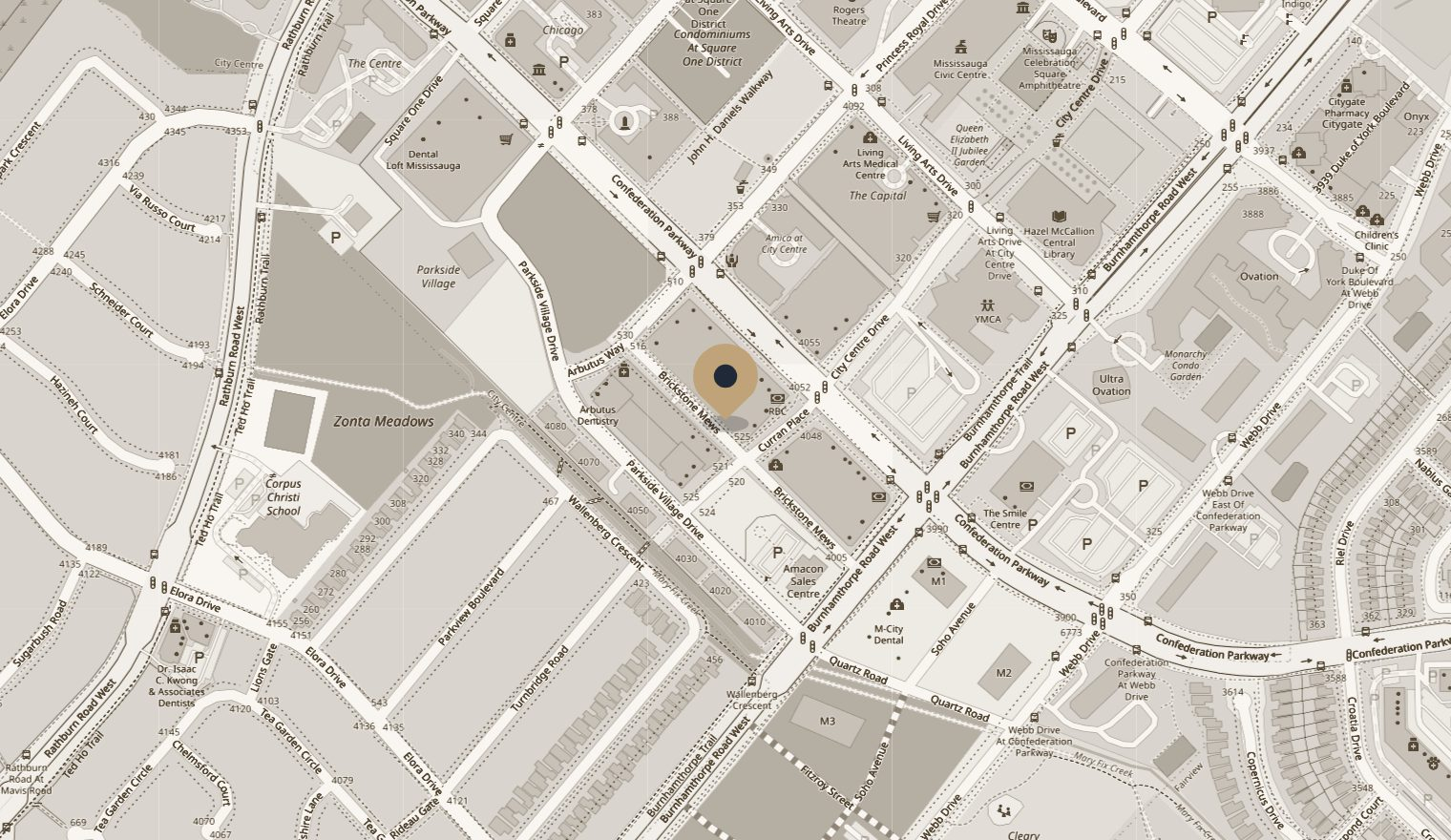
- Locations: hotel names, office and venue addresses, and any restricted loading areas.
- Stops: every planned stop between pickup and drop-off. We charge $25 for an extra stop, so listing them up front keeps the quote accurate.
- Special requirements: child or booster seats, mobility needs, security considerations, dietary or VIP protocol.
- Decision-maker: one person who can approve changes on the day.
- Billing: who pays, whether it goes to a central account, and what documentation finance needs.
For children travelling with a family group, a booster or child seat is $20 on our rates page. Request it when you submit the passenger list, not at the kerb.
Start with the calendar
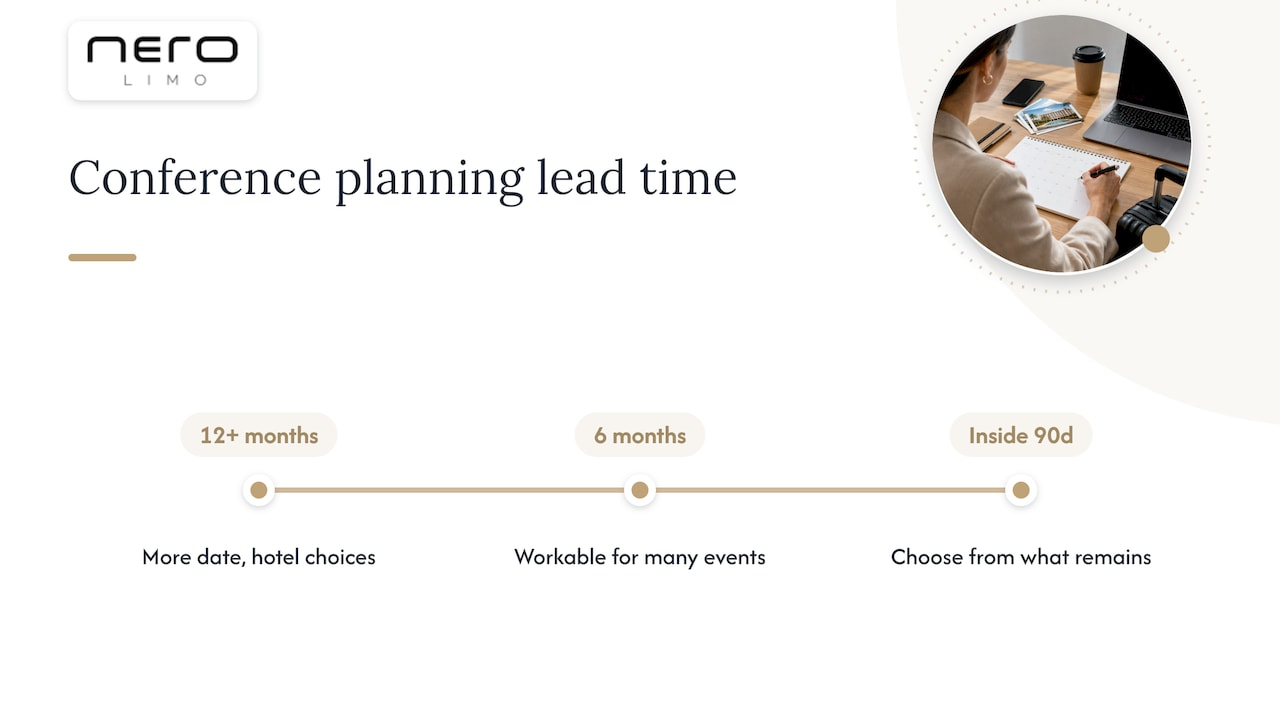
Timing for ground transport follows the event, not the other way round. Planning advice from a Canadian corporate event travel firm says that for a conference with a hotel room block, starting twelve months or more ahead gives more choice of dates, hotels and contract terms. Six months is workable for many events, and inside 90 days planners often choose from whatever remains. International incentive trips need the longer end of that range.
Ground transportation is easier to secure than a hotel block, but it follows the same pattern for large movements. Book vehicles once your hotel and venue are fixed, and lock in group-size and arrival-time assumptions as early as you can. For peak periods in Toronto, such as TIFF, Formula One or major stadium events, book as soon as your dates are confirmed. We handle transportation for TIFF, Formula One and FIFA World Cup movements, and demand on those dates is high.
Build a schedule that survives real life
A corporate travel schedule is a plan with buffers. These rules keep it honest.
Work backward from fixed points
Start with the things that cannot move: a keynote time, a board meeting, a dinner reservation. Subtract travel time, then add a buffer for traffic and loading. Toronto traffic varies by hour and by event, so build the buffer into the plan instead of hoping for a clear road.
Group arrivals by window
If twelve people land across six hours, do not dispatch twelve rides. Cluster arrivals into windows, say every 60 to 90 minutes, and send a vehicle for each window. Those who land early wait briefly in exchange for a smoother, cheaper plan. Executives who cannot wait get a dedicated car.
Plan for multiple stops
Multiple stops are normal in corporate travel: a hotel pickup, a client office, then lunch. Write them in order with an estimated duration at each. For long dwell times, an hourly booking usually works better than a series of point-to-point rides, because the chauffeur and vehicle stay available. Our hourly car service and chauffeur service are built for this kind of as-directed day.
Account for flight changes
Flights move. The plan should track them rather than assume them. We monitor flights proactively so the chauffeur adjusts the pickup to the actual landing time. Give your provider the flight number, not just the time, so that monitoring is possible. For a deeper look at how this works at the airport, see our guide to corporate airport transfers.
Fit travel around meetings
Treat the vehicle as part of the meeting day. A chauffeur who knows the agenda can stage at the right entrance, hold a car during a long session, and be ready when the meeting ends early. Our page on business meeting transportation walks through how to plan this.
Coordinate executive transport with everything else
The best corporate group transportation fits into the rest of the trip. Three habits help.
- One itinerary, shared early. Send the final schedule to the provider, the executive assistants and the on-site lead. Avoid versions floating in email threads.
- One live contact. A dispatcher or coordinator reachable by phone or text on the day. Avoid sending travellers to a generic call centre.
- A written change rule. Decide who may change pickup times, add stops or release a vehicle. This prevents conflicting instructions from three assistants at once.
If you are comparing options for the airport end of a trip, our overview of airport transportation options sets out the choices.
What airport transfers cost with us
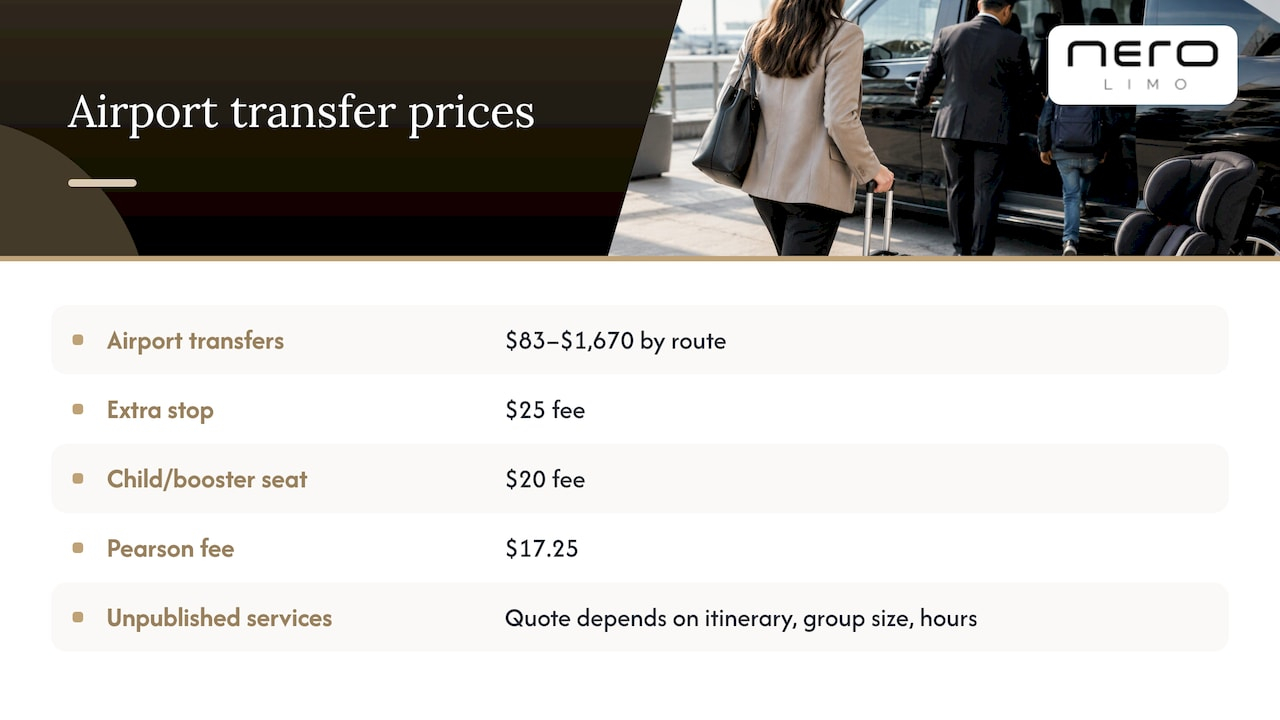
Our published rates for airport transfer service range from $83 to $1,670, depending on the route. Fees are listed separately: $25 for an extra stop, $20 for a child or booster seat, and a $17.25 Pearson Airport fee. Special events, hourly service, chauffeur service and intercity transportation do not have a published price, because they depend on the itinerary, headcount and hours. For those, send us your passenger list and schedule and we will quote the movement.
Vehicle, safety and accessibility checks
Groups include people with different needs, and the checks below belong in the plan from the first draft.
Accessibility
Federal guidance from the Canadian Human Rights Commission says accessibility planning should consider travel policies and procedures and the accessibility of the vehicles made available. It also advises organizations to consult people with disabilities to identify, remove and prevent barriers. In practice, ask every traveller about mobility needs when you collect passenger details, and tell your provider before the date, not on arrival.
Federal rules for transportation providers under the Accessible Transportation for Persons with Disabilities Regulations cover services, equipment, facilities, communications, training and security screening for many modes under federal jurisdiction. In Ontario, the Integrated Accessibility Standards Regulation includes provisions for conventional transportation providers such as deploying ramps or lifting devices on request, allowing adequate time for safe boarding and deboarding, and safe storage of mobility aids. If a traveller uses a wheelchair or other mobility aid, confirm in writing which vehicle and arrangement will be used.
Insurance
A ground transportation specialist at a Concord, Ont. coach company told Ignite Magazine that all commercial vehicle operators must carry at least $8 million in third-party liability coverage, with most increasing to $10 million and larger fleets up to $20 million. Ask any provider for a certificate of insurance and send it to your risk or procurement team.
Practical vehicle checks
- Confirm seat count against headcount, with luggage space on top.
- Confirm child seats for any children in the group.
- Confirm the chauffeur’s name and contact details are sent to each passenger before pickup.
- For cross-border or longer legs, confirm documentation and timing with your provider ahead of time.
Keep it reliable when plans change
Reliability is mostly preparation. These steps cover the usual disruptions.
- Track flights, not times. Delays and early arrivals both happen. Monitoring lets the pickup move with the aircraft.
- Hold a standby vehicle for large events. One spare car for every group of vehicles gives you room for a late executive or a sudden extra passenger.
- Give chauffeurs the full itinerary. They can then reroute around closures and tell the dispatcher when a stop will run long.
- Set a communication rhythm. Passengers receive confirmation the day before, the chauffeur’s details on the morning, and a message when the car is outside.
- Agree a cutoff for changes. Decide how late a change can be made without penalty, and who authorizes it.
- Debrief after the first day. On multi-day programmes, review what worked and fix the schedule for day two.
Our guide to how chauffeur services work for business travellers explains how this kind of hands-on management looks from the passenger’s side.
Our perspective
We have seen that corporate group transportation succeeds or fails in the planning, long before the first car leaves.
Our approach is to manage the movement from start to finish. That means building the itinerary with you, monitoring flights, coordinating chauffeurs, communicating in real time and handling last-minute changes. A single executive airport transfer gets the same discipline as a multi-day event with dozens of passengers and vehicles.
We combine the personal service of a boutique company with the operational capacity to manage complex programmes. Clients tell us what they value most is a team they can reach, that already knows the plan and acts on it. That is what we aim to deliver on every booking, from Toronto across Southern Ontario.
Shan
Plan your group’s travel with Nero Limo
If you are arranging transportation for executives, delegates or event guests, we can take the whole movement off your hands: airport meet and greet, chauffeured transfers, hourly service, intercity legs and event shuttles. Review our services or see airport transfer rates, then send us your itinerary so we can plan it with you. For trips between cities, our intercity transportation page covers the options.
FAQ
How far ahead should I book group transportation?
As soon as your dates, hotel and venue are confirmed. For conferences with hotel blocks, Canadian event travel specialists recommend starting twelve months or more ahead where possible. For peak Toronto events, book earlier still, and send your passenger list as soon as you have it.
What information does a provider need for a group quote?
Give the headcount, dates, pickup and drop-off locations, flight numbers, planned stops, luggage, and any accessibility or child-seat needs. Add the name of the person authorized to approve changes. The more complete the itinerary, the more accurate the quote.
Can one provider handle both executives and a larger team?
Yes. A common setup is black cars for senior executives and Sprinter vans or additional vehicles for the wider group, all running on one itinerary. Tell us the split when you request a quote.
How do you handle flight delays for a group?
We monitor flights proactively and adjust pickup times to the actual arrival. Give us flight numbers for every traveller so we can follow each one and re-sequence vehicles as needed.
Does Nero Limo publish prices for group and event service?
Airport transfers are published on our rates page, along with fees for extra stops, child seats and Pearson Airport. Event, hourly, chauffeur and intercity services are quoted to the itinerary, so contact us with your schedule.
Sources
- Corporate Event Travel Management Canada | Worldgo
- Guidance on Transportation Requirements under the Accessible Canada Regulations | Canadian Human Rights Commission
- Accessible Transportation: Transportation Service Providers guide | Canadian Transportation Agency
- O. Reg. 191/11 Integrated Accessibility Standards | Ontario.ca
- Meetings + Events: All the Right Moves | Ignite Magazine