


Good executive travel planning comes down to five things: a written profile of the traveller’s preferences, a trip built around the meetings that cannot move, one itinerary that holds every confirmation and contact, ground transport that is confirmed and monitored, and a plan B for each key leg. Do those well and the executive’s only job is to show up prepared. This guide walks through each step for assistants, travel managers and event teams, with the Toronto and Southern Ontario details that generic checklists leave out.
TL;DR
- Start with a travel preferences profile (flights, hotels, diet, ground transport, routines) and check every plan against company policy and approval rules.
- Anchor the trip to the meetings that cannot move, then add buffers for traffic, delays and recovery time.
- Keep one itinerary, one page per day, with confirmation numbers, addresses, driver contacts and a plan B, available offline.
- Give your chauffeur provider the flight number, passenger contact, luggage details, destination and the name of the person who can approve changes.
- Confirm ground transport 24 to 48 hours ahead and name who is reachable outside business hours.
Table of Contents
- Start with a plan, not a booking
- Build the traveller profile
- Anchor the schedule to the meetings that cannot move
- Keep spending inside policy
- One itinerary, one source of truth
- Coordinate flights, hotel and ground transport together
- What to give your ground transport provider
- Plan for things going wrong
- Our perspective
- Let us handle the ground leg
- FAQ
- Sources
Start with a plan, not a booking
The most common mistake is opening a booking site before the trip has a shape. Begin with the purpose: which meetings must happen, who the executive needs to see, and what the trip has to achieve. Everything else (flights, hotel, cars) is built around those fixed points.
Then check the trip against policy. The EA Campus advises getting familiar with what has changed in the company’s travel policy: the booking process, spending thresholds, class of travel allowed and who signs off on what. A corporate travel policy typically covers approved booking channels and approval steps, travel standards for flights, rail, hotels and car rental, budget limits, safety requirements and what to do when plans change.
Policies can be strict. The Royal Canadian Mint’s corporate travel policy, for example, requires travel arrangements to go through a designated provider and a traveller profile to be on file before anything is booked. Your own rules may differ, but the principle holds: know the rules before you quote a plan to the executive.
Build the traveller profile
A profile saves you from asking the same questions before every trip. The EA Campus recommends a dedicated document covering:
- Flights: airline memberships, preferred departure times, seat choice, travel class and airlines to avoid.
- Hotels: preferred chains, loyalty memberships, room type and amenities.
- Dietary requirements.
- Ground transportation: the kind of vehicle, whether the executive likes to work in the car, and whether a quiet ride matters.
- Travel routines: how early they like to arrive, whether they work en route, how often they want check-ins.
Reed & Mackay adds a useful habit: keep a master document and check expiry dates on passports and visas, plus loyalty programmes, lounge access and hotel memberships, on a regular schedule rather than trip by trip.
Store this profile securely. It contains passport and loyalty details, so access should be limited to the people who book on the executive’s behalf.
Anchor the schedule to the meetings that cannot move
Put the key meeting, keynote or dinner in the calendar first. Then work backwards. Reed & Mackay suggests checking the calendar in context: is the flight landing only hours before the key event? Its guest expert Fernanda Pinho points to building in breathing space and recovery time as an under-appreciated strategy, since real life rarely matches what looks good on paper.
In practice, that means:
- Avoid tight connections. A short layover at a busy hub turns one delay into a missed meeting.
- Arrive the day before when the meeting is high stakes. Where business circumstances allow, the Royal Canadian Mint policy asks for a suitable rest period after long flights or large time-zone changes.
- Add ground-time buffers. Toronto traffic on the 401, the Gardiner and the QEW is not a constant. Allow for it explicitly rather than hoping.
- Book flexibility where it counts. Aurora Assistants suggests refundable fares or 24-hour holds and risk checks for weather, strikes and minimum connection times.
If you are booking early, note that the Mint policy recommends booking air travel at least 14 days ahead to improve the chance of a lower fare. Your own policy may set a different window.
Keep spending inside policy
Cost control works best before the money is spent. Corporate travel guidance from Bill stresses clear spending boundaries and approval workflows (who can book, through which channels, with which approvals) so policy is enforced up front, not flagged afterwards. It also recommends realistic limits by destination, reviewed at least annually.
Public-sector rules show how formal this can get. The Canada Revenue Agency’s travel directive requires pre-approval through a Travel Plan within authority limits, and reimbursement for an unapproved alternate mode of transport cannot exceed the cost of the authorized one. You do not need to copy that, but it is a good model: decide who approves what, and write it down.
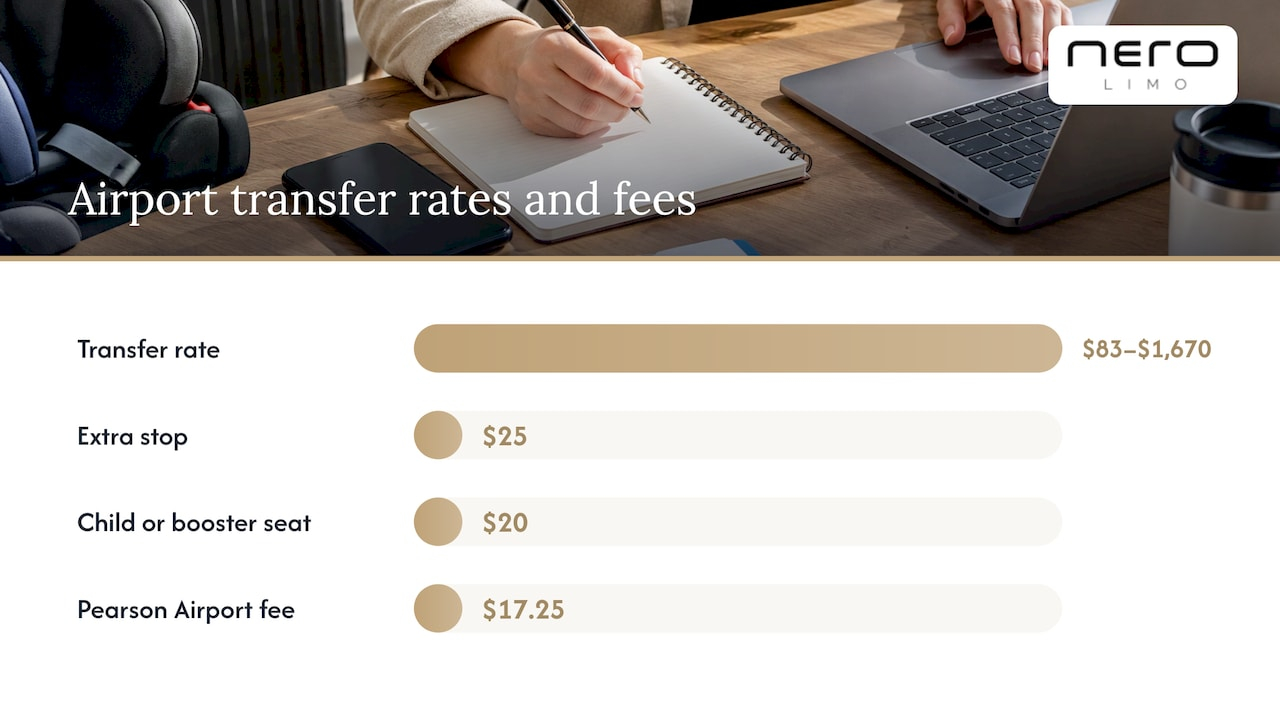
For ground transport, this is where a clear quote helps. Our published airport transfer rates run from $83 to $1,670, and the add-ons are listed too: an extra stop is $25, a child or booster seat is $20, and the Pearson Airport fee is $17.25. You can see the full list on our rates page, which makes it easier to pre-approve a trip without surprises on the expense report.
One itinerary, one source of truth
The itinerary is the document the executive actually uses, so it has to be complete and easy to scan. Perk recommends a single itinerary covering flights, rail, hotel and car rental, with confirmation numbers, departure times, terminal addresses, seat information, supplier and driver contacts, meeting details, emergency contacts and relevant policy reminders. It should be available digitally and offline, for example as a PDF.
How to organize it
Corporate Traveller Canada advises organizing chronologically and grouping by day, with the most important details, such as flight times and hotel check-in and check-out, highlighted at the start and end. Veil Concierge goes further: one page per day works better than one long document, and each leg should carry the local time, the address, the confirmation number, a contact name and phone number, and a plan B.
What to put on each page
Here is a working template for a day in Toronto:
| Item | What to include |
|---|---|
| Arrival | Airline, flight number, terminal, scheduled arrival, how the executive is met |
| Ground leg | Chauffeur name and mobile, vehicle, pick-up point, drop-off address, buffer built in |
| Meetings | Time, address, attendee names, topic, a phone number at the location |
| Hotel | Name, address, confirmation number, check-in and check-out times |
| Meals | Restaurant, reservation time, dietary notes |
| Plan B | Alternate route or car, who can authorize changes, assistant’s direct line |
| Emergency | Local emergency numbers, company contact, insurance details |
Navan’s checklist adds a few details worth stealing: a map for every booking, copies of critical documents such as passport photos and insurance numbers, and policy thresholds written directly into the document. Executive Support Magazine also lists biographies of the people being met, dress codes for functions and the weather for packing. Pick what suits your executive; a long itinerary nobody reads defeats the purpose.
Coordinate flights, hotel and ground transport together
Treat the three as one chain, not three bookings. Veil Concierge frames the work across planning, ground movement, accommodation and workspace, information, and monitoring and recovery. The practical questions are simple: who meets the executive on arrival, how do they reach the hotel or the meeting, and how do they get back to the airport with a margin to spare?
On the ground in Toronto, several things shape the answer:
- Pearson terminal and pick-up point. Decide whether the chauffeur meets the executive inside arrivals or at the kerb, and put that in the itinerary.
- Hotel and meeting location. Downtown, the Financial District and Yorkville are close together on a map, but a congested afternoon makes them feel far apart.
- Beyond the city. Trips to Oakville, Burlington, Hamilton or Niagara-on-the-Lake are common for client visits and site tours. A single intercity booking is simpler than juggling separate rides.
- Border and entry documents. Foreign visitors flying in need the right paperwork. Immigration, Refugees and Citizenship Canada states that visa-exempt foreign nationals arriving by air need an eTA, linked electronically to the passport and valid for up to five years or until the passport expires, whichever comes first. It also notes that an eTA does not guarantee entry. Check requirements on the official site before you book.
For more on the chauffeur side of this chain, see our guide on how chauffeur services make business travel easier.
What to give your ground transport provider
Whether it is a single airport transfer or a delegation of twenty, the provider can only perform as well as the brief it receives. For each movement, confirm:
- The passenger or group, and a mobile number that will actually be answered.
- The flight number, so arrival can be tracked and delays absorbed.
- The exact collection point and the drop-off address or venue entrance.
- The time the executive must arrive, not just the time they leave.
- Luggage or equipment, and any mobility or assistance needs.
- The person authorized to approve changes.
- What the vehicle does after arrival: wait, return later or stand by for the day.
This list follows the guidance in MCR Exec’s major-event planning guide, which also recommends checking venue access at the intended time, vehicle access and accreditation, separate arrival and departure points, and an alternative meeting point. We cannot link to every provider’s page, but the checklist is sound whoever you book with.
For groups, Vancouver International Airport recommends reservations that include pick-up date, estimated pick-up time (45 minutes to an hour after flight arrival), arrival flight information and group size, plus a greeter inside the terminal to gather the group and coordinate with drivers. The same logic applies at Pearson: the more passengers, the more a named greeter and a written plan matter. Our guide to corporate group transportation covers how to structure these bookings, and our airport pickup and drop-off guides cover the airport specifics.
Plan for things going wrong
Perk’s guidance is that contingency planning should be proportionate to risk and cover flight disruption, accommodation problems, illness or injury and anything else that changes the trip. Practically, that means:
- Emergency contacts are current for every traveller before departure.
- Each key leg has a plan B: an alternate flight, a later car, a different meeting point.
- Someone is watching. A monitoring layer tracks flights and connections and can rebook, reroute or reschedule before the executive has to ask.
- Disruption contacts are documented, with more than one way to reach them and a 24/7 point of contact.
- Receipts are kept for extra expenses, and devices stay charged.
For international destinations, Perk also suggests local emergency numbers, nearest hospitals and embassy contacts, and the Royal Canadian Mint policy recommends consulting official travel advisories at voyage.gc.ca before making plans. Before booking, check passport validity, visas or electronic travel authorizations and insurance details, as Veil Concierge advises, so you find problems before the airport does.
Finally, reconfirm. Reed & Mackay recommends re-checking ground transport, restaurant bookings and high-priority meetings 24 to 48 hours before departure. Ten minutes of calls is cheaper than a missed keynote.
Our perspective
Most executive trips do not fail at the flight. They fail in the gaps: the arrival nobody tracked, the driver who never had the new meeting time, the schedule change at 6 p.m. that nobody could act on.
That is why we do not think of ground transportation as a vehicle booking. We plan the movement from start to finish: flight monitoring, itinerary planning, chauffeur coordination and real-time communication when the day changes. For one executive, that means a chauffeur who knows the plan and tracks the flight. For a conference or roadshow, it means a team managing many passengers, vehicles and destinations as one operation.
Our advice to assistants and travel managers is to treat your chauffeur partner as part of the itinerary, not an afterthought to it. Share the profile, share the schedule, name who can authorize changes, and expect a partner who communicates before you have to ask. We combine the personal attention of a boutique company with the operational discipline that corporate travel demands, and that is the standard we hold ourselves to on every trip.
Shan
Let us handle the ground leg
If you are planning a trip to Toronto or Southern Ontario, we can take care of the ground movement: airport transfers, hourly chauffeur service for a day of meetings, intercity transportation to cities such as Hamilton, Niagara Falls and Niagara-on-the-Lake, and event and venue transportation for groups. Send us the itinerary and we will build the transport around it. Browse everything on our services page or start from Nero Limo.
FAQ
What should an executive travel itinerary include?
At minimum: flight details and confirmation numbers, hotel name and address, ground transport with driver contact, meeting times, locations and attendees, and emergency contacts. Group it by day and make it available offline, such as a PDF. Add a plan B for each key leg.
How far ahead should I confirm airport transport?
Book as soon as the flight is set, then reconfirm 24 to 48 hours before departure, as Reed & Mackay recommends. Give the provider the flight number, passenger phone number, luggage details and destination so they can track arrival and adjust for delays.
How much does an airport transfer in Toronto cost?
Our published airport transfer rates range from $83 to $1,670. Add-ons are listed separately: $25 for an extra stop, $20 for a child or booster seat and $17.25 for the Pearson Airport fee. See our rates page for details.
Who should be able to authorize changes during a trip?
Name one person, usually the executive assistant or travel manager, and give your provider their direct number. Perk recommends establishing who can authorize changes and how the traveller can get support outside business hours. That way a late change does not stall while people try to reach each other.
Can one provider handle both a single executive and a group?
Yes, if the provider manages operations as well as vehicles. We handle single executive transfers as well as multi-vehicle events, with the same planning and real-time coordination. For groups, share passenger numbers, flight details and venue access requirements early.
Sources
- The complete guide to corporate travel planning, Perk
- Corporate travel policy, Royal Canadian Mint
- Complete Guide to Planning Business Travel for EAs, The EA Campus
- Executive Travel Planning, Aurora Assistants
- 12 practical corporate travel strategies for EAs and PAs, Reed & Mackay
- Directive on Travel, Canada Revenue Agency
- Corporate Travel Planning: A Complete Guide, Bill
- Business Travel Itinerary Guide, Corporate Traveller Canada
- Travel Coordination for Executives, Veil Concierge
- Executive travel itinerary checklist, Navan
- Organising Your Executive’s Travel, Executive Support Magazine
- eTA facts, Immigration, Refugees and Citizenship Canada
- Group Arrivals at the Airport, YVR
- Major-Event Ground Transportation Planning Guide, MCR Exec